
This guidance is written for semi trucks, tractor-trailers, box trucks, straight trucks, and commercial fleets. It does not replace a physical inspection, manufacturer instructions, fleet policy, emergency authority direction, or applicable law.
 Skip to content
 Commercial Truck Education
Warning lights, performance changes, temperature movement, unusual noise, smoke, leaks, and repeated starting problems are operating information—not inconveniences to ignore. Early documentation and diagnostics can help prevent a developing issue from becoming a roadside failure.
Published and reviewed by Lonestar Diesel · July 14, 2026 · Commercial educational content
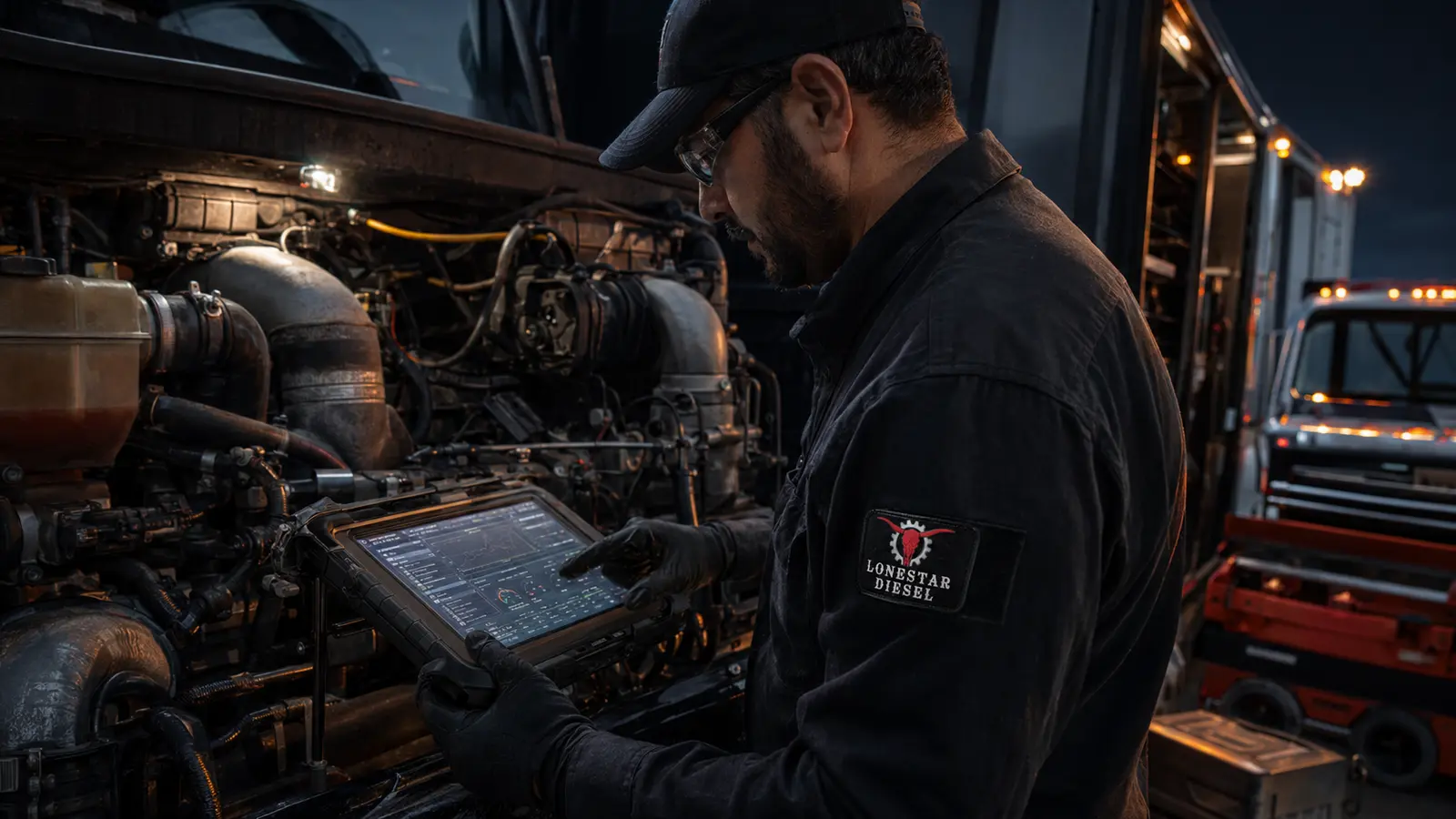
This guidance is written for semi trucks, tractor-trailers, box trucks, straight trucks, and commercial fleets. It does not replace a physical inspection, manufacturer instructions, fleet policy, emergency authority direction, or applicable law.
Record the indicator, message, fault information, operating condition, and whether the truck entered a reduced-power state. Clearing a code without diagnosing the cause removes information and can delay the correct repair.
Rising coolant temperature, repeated coolant loss, oil-pressure changes, visible leaks, or fluid odor require attention. Continuing to operate may increase repair scope, create a safety concern, or leave the truck disabled in a less accessible location.
Slow cranking, intermittent power, dim lighting, repeated battery discharge, clicking, charging warnings, or communication faults may involve batteries, cables, grounds, starters, alternators, circuits, or control systems.
Performance symptoms can involve air, fuel, sensors, aftertreatment, turbo, electrical inputs, cooling, or engine condition. The operating context and diagnostic data help separate overlapping causes.
Common indicators include hard starting, warning lights, derates, temperature changes, power loss, unusual smoke or sound, leaks, rough running, charging warnings, and repeated fluid loss.
Not necessarily. A fault code identifies a condition detected by the control system. Testing, circuit information, operating context, and physical inspection are needed to determine the cause.
Continuing to operate can create a safety concern and increase damage. Follow fleet and manufacturer procedures, move to a safe location when possible, and obtain qualified guidance.
Mobile diagnostics can capture useful evidence at the vehicle. Intermittent faults may still require extended monitoring, specialized equipment, or controlled shop testing.
Call with the exact location, vehicle type, symptoms, warning information, and urgency.
Verified Google map: This embedded map is connected to the Lonestar Diesel Google Maps entity. Service availability still depends on the exact truck location, direction of travel, access conditions, repair scope, and dispatch capacity.


 Optimized by Seraphinite Accelerator