
This guidance is written for semi trucks, tractor-trailers, box trucks, straight trucks, and commercial fleets. It does not replace a physical inspection, manufacturer instructions, fleet policy, emergency authority direction, or applicable law.
 Skip to content
 Commercial Truck Education
When a semi truck will not start in Dallas–Fort Worth, the fastest safe response begins with accurate symptoms—not random parts replacement. This guide helps drivers, dispatchers, owner-operators, and fleet managers document a commercial no-start and decide whether mobile diagnosis, roadside repair, or towing is the appropriate next step.
Published and reviewed by Lonestar Diesel · July 14, 2026 · Commercial educational content
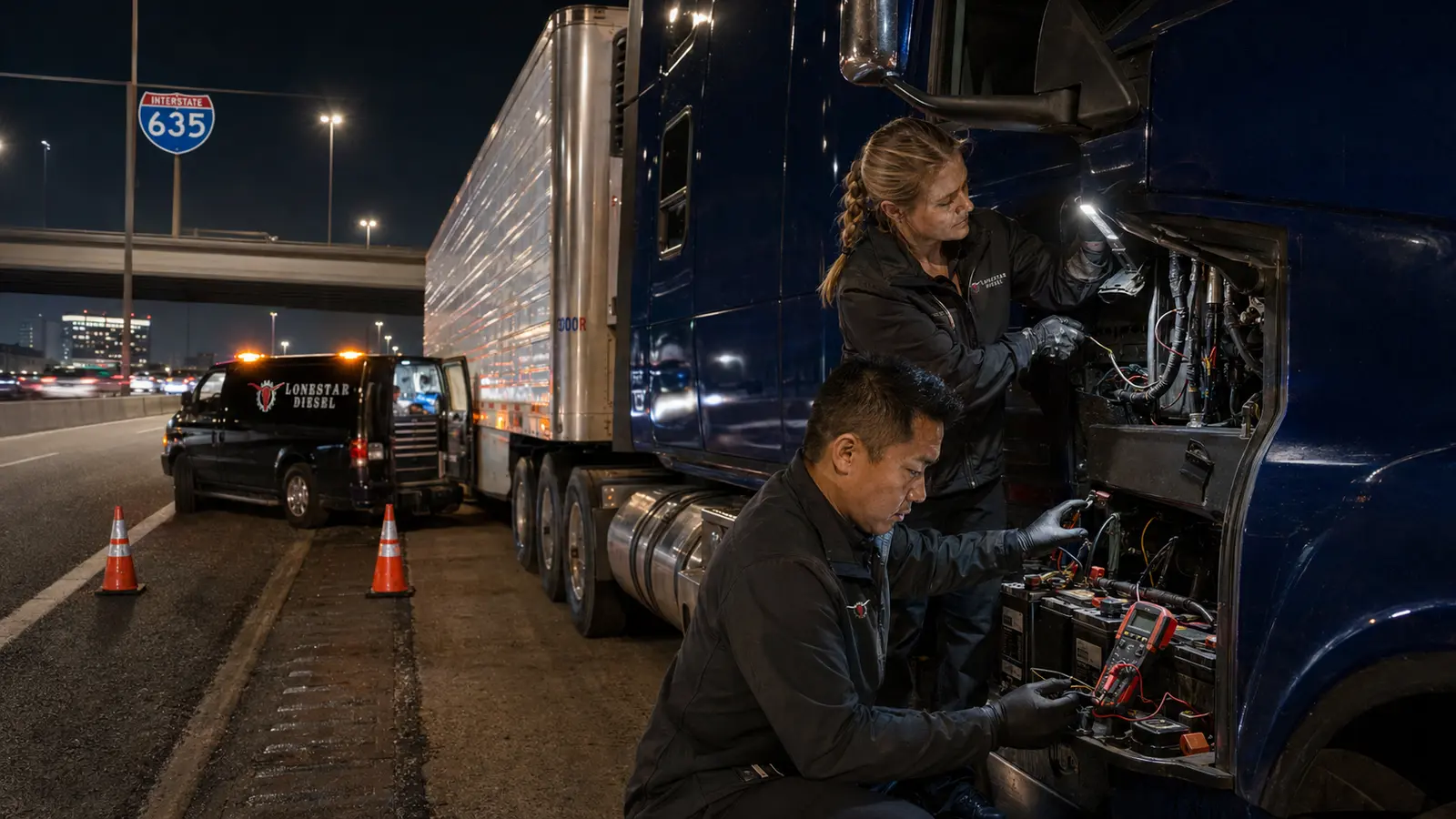
This guidance is written for semi trucks, tractor-trailers, box trucks, straight trucks, and commercial fleets. It does not replace a physical inspection, manufacturer instructions, fleet policy, emergency authority direction, or applicable law.
Move out of active traffic only when it can be done safely and legally. Use hazard systems and required warning devices, identify the exact roadway or facility location, and contact emergency authorities when the disabled vehicle creates an immediate hazard. Do not work around batteries, rotating components, fuel, or traffic without appropriate training and protection.
Report whether the engine cranks normally, cranks slowly, clicks once, clicks repeatedly, loses dashboard power, starts and stalls, or does nothing. Record warning messages, voltage readings supplied by the vehicle, recent jump starts, weather, idle time, and whether the condition changes when the engine is hot or cold.
Slow cranking, dim lighting, intermittent power, heat at a connection, or repeated discharge may involve batteries, cables, terminals, grounds, the starter circuit, or excessive resistance. A voltage reading alone does not prove that a battery or cable can carry the required cranking load.
A truck that starts after a boost but loses power again may have an alternator, belt, wiring, connection, battery, or parasitic-load issue. The correct diagnosis should test the system under relevant operating conditions and verify the repair instead of treating every recurrence as a battery-only problem.
Normal cranking without starting can involve fuel delivery, air intrusion, sensors, wiring, control modules, security or interlock inputs, aftertreatment conditions, or mechanical faults. Preserve fault information and operating context; clearing codes or repeatedly cycling power can remove useful evidence.
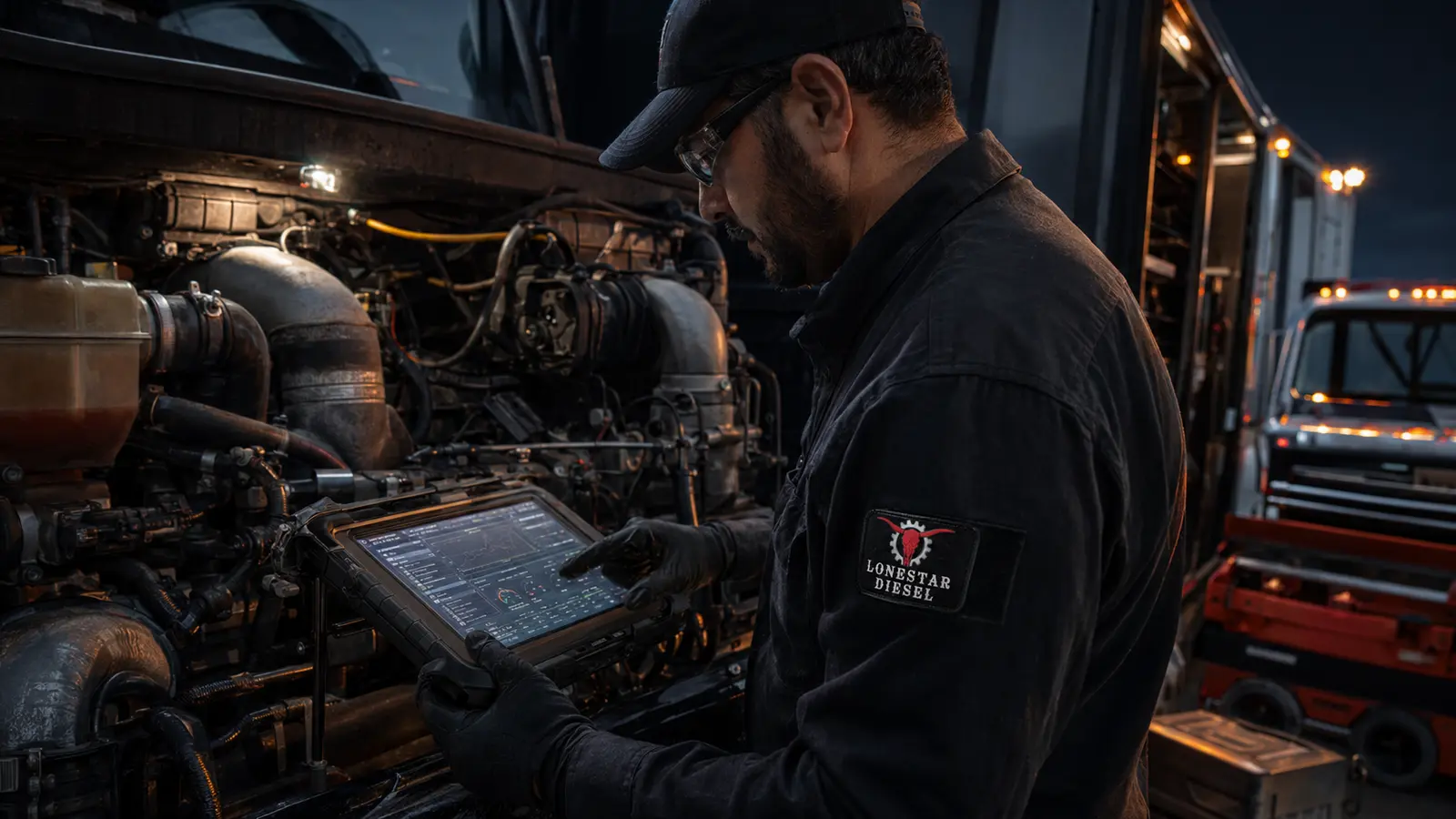
Share a map pin, direction of travel, unit and trailer details, access restrictions, crank behavior, warning messages, recent repairs, fuel level, photographs, and whether a safe work area exists. Better dispatch information helps the technician prepare appropriate testing equipment and service direction.
Towing or a controlled shop environment may be required when the location is unsafe, access is restricted, heavy disassembly or lifting is needed, parts are unavailable, environmental conditions prevent verification, or the truck cannot be returned to service safely at the location.
Possible causes include discharged or failed batteries, high-resistance connections, cable or ground faults, starter-circuit problems, interlock inputs, or a starter issue. Testing is needed before selecting a part.
Often, yes, when the truck is safely accessible and field testing is appropriate. The repair itself still depends on the verified cause, parts, tooling, access, and safe verification.
Repeated attempts can drain batteries, overheat components, remove diagnostic evidence, or worsen some conditions. Follow fleet and manufacturer procedures and obtain qualified guidance.
Send the exact location, unit details, crank behavior, dashboard messages, recent repairs, fuel status, access conditions, photographs, and any reliable voltage or fault information already available.
Call with the exact location, vehicle type, symptoms, warning information, and urgency.
Verified Google map: This embedded map is connected to the Lonestar Diesel Google Maps entity. Service availability still depends on the exact truck location, direction of travel, access conditions, repair scope, and dispatch capacity.
 Optimized by Seraphinite Accelerator